Bye 2025 and Happy New Year 2026

2025 is gone.

365 days, 24 hours each — finished in the blink of an eye.

Some days felt like blessings.

Some were just okay.

Some made me question everything.

And some, honestly… I didn’t want to end at all.

While others, I couldn’t wait to skip past, just to see what the next day brought — a miracle or fresh drama.

One thing 2025 taught me clearly:

Most of us, including me, said at least once —

“Nobody appreciates what I do” or “I give more than I receive.”

So maybe the truth is —

we all failed a little in appreciating, and a little in feeling appreciated.

And no amount ever feels enough.

But today, I want to do it differently.

To every person who stood by me this year —

in presence, in silence, in care, in lessons, in love, even in distance —

thank you.

For the support I asked for, and also for the support I never did.

We often mistake blessings as burdens —

like a parent’s call that feels annoying when we’re busy,

but is a dream for someone who doesn’t get that call anymore.

Perspective changes everything.

So if I ever hurt you, ignored you, or took you for granted —

I’m sorry.

And if anyone took me for granted — I forgive you, and myself too.

Because the best thing about 2026 isn’t knowing what it holds,

but knowing who I hold in my life.

The right people can make even the falling days feel softer.

So, thank you for staying.

Thank you for leaving if you had to.

Thank you for the role you played either way.

2026 mantra:

• Appreciate more

• Expect less

• Take nothing for granted

• Keep your circle intentional

2025:

Appreciate what people did for you — even if it wasn’t perfect, even if it wasn’t returned.

Let go where appreciation was missing.

Choose peace. Choose joy.

2026:

Surround yourself with the ones who matter.

Love them loudly, value them deeply.

Happy New Year!

May we all appreciate more and regret less.

— Tanay ✨

The Goddess We Worship, The Woman We Forget

We fold our hands and bow before Goddess Durga, asking her to bless us. Yet, when the same goddess walks beside us in the form of a woman, what do we do?
We mock her.
We humiliate her.
We use her, abuse her, pass her over, ogle at her, disregard her, and disrespect her.

We call India a land of rich culture, traditions, and values. We proudly celebrate our festivals — Navratri, Dussehra, Durga Puja — and remind ourselves of how good always triumphs over evil. Yet, when I look through the “lens of a woman,” this celebration often feels hollow.

For nine nights, we worship the Goddess:

We narrate the story of Durga defeating Mahishasura.

We remember Lord Rama’s victory and his return with Sita.

We perform Ayudha Puja and bow to the tools that sustain us.

But do we bow to the women who sustain us?

Growing up, I saw how different boys and girls were treated. When a boy made a mistake, he was scolded. When a girl made a mistake, she was reminded: “Ladki ho tum. Behave properly.”
Why? At the end of the day, aren’t both children?

Even today, the birth of a girl in many families is looked down upon. A girl is still seen as a “liability.” Why? Because society demands more protection, more restrictions, more compromises for her. Because, one day, she will “leave” her parents’ home and enter her husband’s house. And so, her education becomes an “expense,” her dreams an afterthought. Ironically, the same people who reject the birth of a girl desperately want one as a bride for their sons.

Our customs reinforce this divide. Sons are considered heirs to the family. Daughters are not — because they “take another man’s name.” Children of sons are celebrated as “our children.” Children of daughters somehow “belong to another family.” When a child succeeds, it’s his father’s pride. When a child errs, it’s his mother’s failure.

And when it comes to behavior, the scale tilts again.


If a girl listens to everything she is told, she becomes the “obedient daughter” who has upheld the dignity of the house.


But if she dares to refuse, to question, or to choose her own path, the verdict is quick: “Naak katwa diya tumne. My prestige and name has been ruined.”

And what is expected of women? To run homes flawlessly, to compromise endlessly, to adjust without protest. To work in offices with peak performance, then return home to cook, clean, and care. She must understand everyone. But who truly understands her? Often, not even other women — who, shaped by generations of silence, say: “Yeh sab adjust karna padta hai. Isi tarah chalta hai.”

And yet, during these nine days, the same woman — ignored, burdened, disrespected all year round — is suddenly worshipped as a goddess. Is this devotion, or hypocrisy?

We forget that when everything fails, when every man falters, it is the woman he turns to for strength, comfort, and refuge. Durga herself reminds us — when loved, respected, and honored, she is Shakti, the life force. But when insulted, abused, and wronged, she is Kali — fierce, unstoppable, and terrifying.

As I end this reflection, I bow my head to all the Durgas and Kalis around us and also to my mother and sisters, who have been “My” “shakti“. Thank you for carrying the weight of this world on your shoulders, even when it goes unseen. Without you, there is no life.

May the day come when women are not just worshipped for nine nights, but respected for all their days. Because women are not “equal” to men — they are far more than men can ever be.

Why true Peace needs strength: A Lesson from the Guru

There was a gurukulam with a few disciples in the southern parts of India. One day, a disciple approached his Guruji and asked:

Disciple: “Guruji, you teach us many things. But two of your teachings intrigue and confuse me. You ask us to be the strongest people we can be, and yet, you also ask us to follow non-violence. If I cannot use my strength, then why did you make us strong in the first place, only to tell us not to use it?”

Guruji: “Do you see the great mountain behind our gurukulam?”

Disciple: “Yes, Guruji, I do.”

Guruji: “Do you think I could climb to its peak in half a day?”

Disciple: “You are strong, Guruji, but I think it is impossible even for you. Even I, in my prime, would take more than half a day to climb it.”

Guruji: “Good. Now, what if I asked you to climb it in half a day or less? What would you say?”

Disciple: “I would tell you, Guruji, that it is not possible for me.”

Guruji: “And if I forced or pressured you to do it?”

Disciple: “Then I would ask—were you able to do it when you were my age? Or I would say, Guruji, please show me how to do it first. If you can, then I will try.”

Guruji smiled.

Guruji: “Exactly. That is why I trained you in warfare. Not because you must always use it, but so that you and others understand that violence is not the solution to all problems. When a weak man preaches non-violence, people dismiss it, saying he speaks so only because he cannot fight. But when a strong man, fully capable of fighting, chooses non-violence—people listen. They know it comes from wisdom, not weakness. Remember this: it is always better to be a warrior in a garden than a gardener in a battlefield. When you have strength yet choose peace, people will respect you, because you are showing them a higher path—that strength must be used only when necessary.”

The disciple bowed.

Disciple: “Thank you, Guruji, for enlightening me. But just as we disciples listened to you and became who we are today, won’t others also do the same?”

Guruji: “Let me tell you the story of Raja Hemanand Pratap Varma…”

The Tale of Raja Hemanand Pratap Varma

Raja Hemanand Pratap Varma was a just and kind king. His people loved him deeply, for he was wise and compassionate. Under his rule, there was peace and prosperity—no crimes, no wars, only flourishing trade and happiness.

Whenever rival kings threatened war, Hemanand would ask them: “What is it that you truly need? Why waste lives and resources? Let us resolve this peacefully.” He always extended the olive branch, providing what they sought to avoid bloodshed.

This attitude stemmed from his past. As a child, Hemanand was weak and often bullied. His father, a warrior king, had died in battle. From that time, Hemanand vowed never to follow the path of violence. He shunned warfare and physical training, choosing instead to rule through peace.

His ideals made his kingdom prosper. Neighboring kings saw him as harmless, and merchants from far and wide flocked to his peaceful, wealthy land. But this very prosperity attracted the attention of Virata Samrat, a cruel and greedy ruler.

Virata challenged Hemanand: “Let us wage war. The victor shall rule both kingdoms.”

But Hemanand stayed true to his ideals. He refused bloodshed and instead sent 1,000 carts of gold, saying: “Let us avoid war, for it will only destroy our people. Accept this token, and let us live as friends.”

Virata was astonished—yet insulted. He thought: “If Hemanand can spare 1,000 carts of gold for peace, how much more treasure must he hold? And how dare he imply that I can be bought?”

His pride wounded, Virata decided to exploit Hemanand’s weakness—his kindness. He accepted the offer, pretended friendship, and slowly gained Hemanand’s trust. Soon, he sat in the king’s court, influencing matters of state.

Once he had learned enough, Virata struck. He betrayed Hemanand, killed him, and exiled his wife and son. Virata seized the throne and ruled the once-prosperous kingdom with cruelty.

Guruji’s voice grew solemn.

Guruji: “Do you see, my child? Raja Hemanand had peace in his heart, but no strength to protect it. Peace without strength is fragile, like a lamp in the wind. Strength without peace is destructive, like fire in the forest. True wisdom is in having both—strength to defend, and the will to choose peace.”

The disciple bowed deeply, his doubts dissolved.

Disciple: “Now I understand, Guruji. Peace is indeed the greatest weapon—but only when it is guarded by strength.”

Edit courtesy: ChatGpt

Speak Like It’s a Spell

Laundpana – Speak Like It’s a Spell

How often do you hear people telling you not to talk too much about yourself, or to always pronounce and spell things correctly? I don’t know how true what I’m about to say is, but I truly believe it.

There’s this one rap song I stumbled upon on YouTube — Laundpana by Kayden Sharma[1]. It had been a long time since I enjoyed a rap this much, not since Apna Time Aayega from Gully Boy. While listening to this track, a few lines hit me hard. They made me feel that the advice to not speak less about yourself and to speak clearly isn’t just a social nicety — it might actually be backed by something deeper, maybe even science.

Here are a few lines from the song that really stood out:

“HALLU HALLU SACHAI HAI BADALRAUN MEIN KHWAAB”

“KITTE KI SAALON SE HUMLA BHOOKKE BAITHE”

“KAYDEN BADE LOG KE SATH UTH TA BAITHTA NAHI”

“BADE LOGAAN KAYDEN KE SATH UTHTE BAITHE”

“TV PE AANE KE BAAD MAIN SUPERSTAR NAHI BANA”

“SUPERSTAR THA ISKE LIYE AAYA MAIN TV PE”

Every time I listen to this song, it reinforces my belief that the way we speak about ourselves — especially to ourselves — can truly shape our lives.

As I planned to write about this song, I didn’t want to do it blindly. So I did a bit of research. That’s when I found something fascinating: the word spell doesn’t just mean to spell out letters. Historically, it also refers to casting a spell[2]. That really struck a chord with me. It’s no wonder that clear, confident, and positive speech is so powerful. The words we use literally shape our perception — of ourselves and of the world around us.

Think about it. Every great leader in history was a powerful speaker and a believer in themselves. They didn’t downplay their worth or wallow in a victim mindset. They spoke with confidence and faith in their journey, no matter how hard life hit them.

One story that demonstrates the power of belief and words is that of Nick Sitzman[3]. He was accidentally locked inside a freezer overnight. He panicked, convinced he would freeze to death. The next morning, he was found dead — cause of death: hypothermia. But here’s the twist — the freezer wasn’t working at all that night. It had malfunctioned and wasn’t even cold. Nick died not from the actual cold, but from the belief that he was freezing.

His mind made it real. That’s how powerful our thoughts, words, and beliefs are. So, to conclude:

You can shape your reality by the way you speak — especially about yourself. Speak with belief. Speak with power.

Spell it like a spell.

[1] Laundpana by Kayden Sharma – YouTube: https://www.youtube.com/watch?v=0MdSpxab89A

[2] The word “spell” and its magical roots – Medium: https://medium.com/@theawakenedstate/the-magic-of-spelling-words-41936db32bc4

[3] Nick Sitzman freezer death story – Psychology Today: https://www.psychologytoday.com/intl/blog/how-risky-is-it-really/201006/dying-thought

Chit Chaat Friends

“You can choose your friends but you cannot choose your family.” – Harper Lee

We’ve probably heard this quote more than once—it reminds us that while we don’t get to choose our family, we absolutely get to choose our friends. And choosing them wisely matters, because we become the product of the people we surround ourselves with.

As a child, I had a beautiful fantasy. I imagined that when I grew up, I and my best friends—my childhood gang—would start businesses together, become rich, and buy homes next to each other. I even had a detailed plan where four of us (my closest school friends) would build homes in the shape of a square, all connected through a central shared space. That middle area? It was for our families to hang out, relax, celebrate together. Just us—our own little world.

That fantasy meant the world to me. And like all heartfelt fantasies, it stayed one—because “life is lifing,” as people say now. That vision remained locked away in a childhood corner of my mind… until recently, when I saw someone live a part of that dream in real life.

Now here’s another of my slightly less sentimental but equally passionate dreams: to eat pani puri from every single place I could find. Not just the shop ones—but from thelas, bandis, roadside stalls, carts, bicycles—you name it. While that wasn’t realistically possible, I did the next best thing. I began trying pani puri from every place I heard was good.

That’s when I stumbled upon Chaat Carnival in Secunderabad.

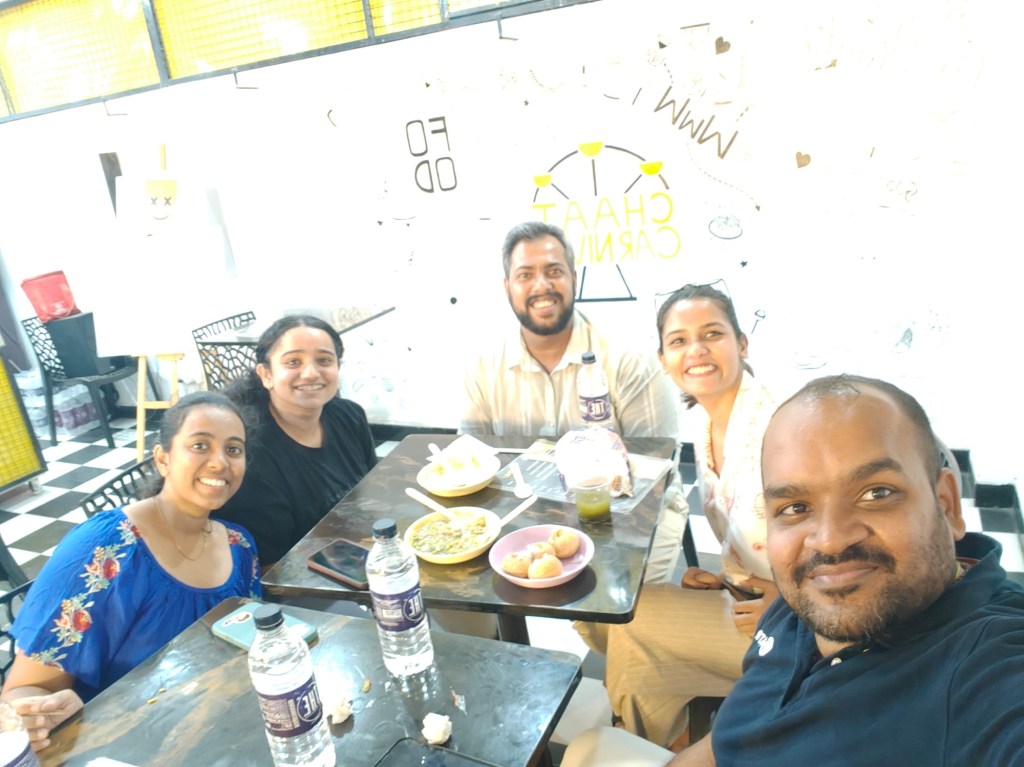
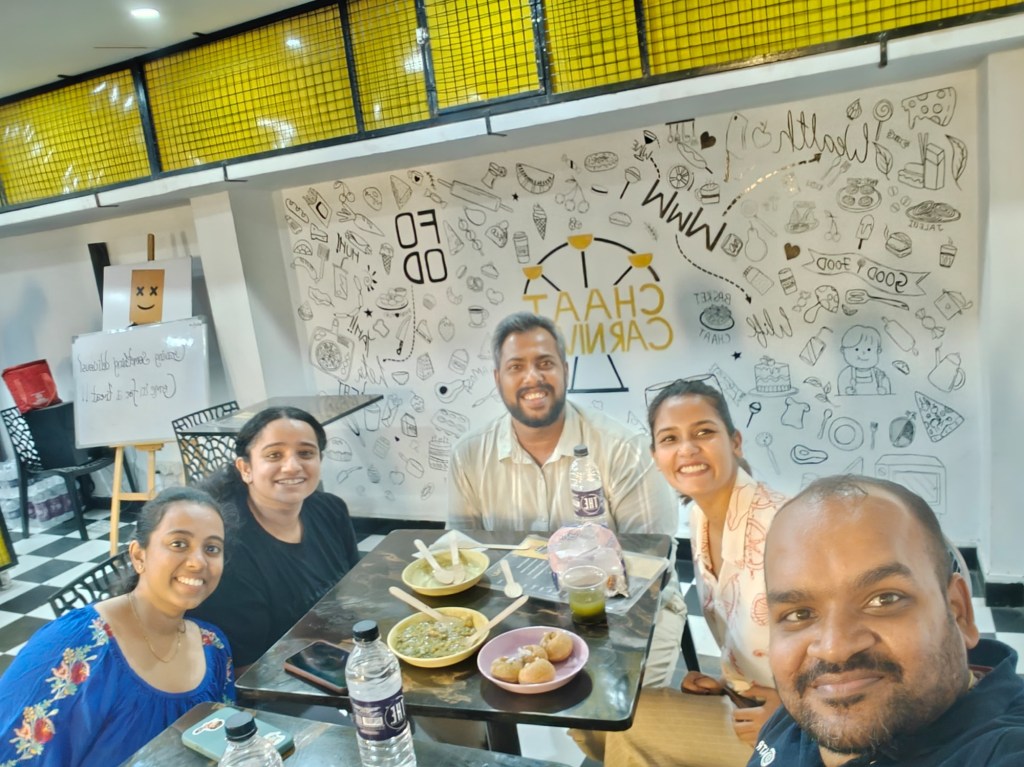
The real essence of ‘chit chaat’—food, friends, and shared laughter.

At first glance, it looked like just another chaat joint. And I won’t lie—my first thought was, “What’s so special about this place?” My friend, who is one of the business partners, had asked me to visit. I honestly assumed it was just a polite attempt to promote her business.

But the moment I stepped in, I knew I had misjudged it.

I was warmly welcomed and made to feel at home. The place has a vibe—a simple, warm, cheerful setting where families, friends, and couples can unwind and just enjoy great food. But what truly amazed me was not just the taste of the food—it was the story behind it. It was the people.

One of the Founders at Chaat Carnival (the one in the black tee 2nd one from the left)

From childhood mischief to running a business—some friendships go the distance.

The business is run by three childhood friends. And let me tell you—this is not just a business for them. It’s passion. All three have full-time jobs, and two of them are professional photographers. Yet, they chose to create this place, not to mint money, but to serve food they love making.

Food, for them, is a language of love. They’ve poured their hearts into Chaat Carnival. Every dish I tried was absolutely spot-on. Unique in flavor, perfect in preparation, and above all, made with joy. The taste was so good, I had to go back again—just to let my taste buds relive that joy.

These three friends didn’t grow apart with time like most people do. They grew together—from childhood best friends to business partners, choosing not just to build something profitable but to build something purposeful.

Their goal? Simple:
To give people a space where they can chit-chat over chaat, with food that’s tasty, hygienic, and served with heart.

And as if that wasn’t already beautiful enough, they’ve taken it a step further.

All three of them are dog lovers. Since they can’t adopt every stray, they decided to contribute in a small but deeply meaningful way. Right outside the shop, they’ve placed a free feeding station for street dogs—with dog biscuits for anyone to pick up and feed our furry friends.


“If I can’t adopt one, why not help many?” – A gesture that speaks volumes.

This… this is what it looks like when passion, dreams, friendship, and kindness come together.

Chaat Carnival is not just a place to eat. It’s a place to feel. A place where memories are made, friendships are celebrated, and humanity is served—on a plate and beyond.

They didn’t just create a business.
They built a home of fun, friends, dreams, and happiness.

Kudos to them. Truly.

If you ever find yourself in or around Secunderabad, do drop by Chaat Carnival.

https://maps.app.goo.gl/Rfmg19VXoA1ictin9

You might go there for the food,
but you’ll leave with a full heart.

P.S. This isn’t a paid promotion. I just genuinely loved their story and felt it deserves to be shared with the world. ✨ and a special thanks to ChatGpt for helping out in ironing out the wrinkles of this post.