
Read chapter one here:
Mushika was not born out of ambition.
It was born out of necessity.
I observed two realities everywhere around me.
First—aging parents living alone while their children work in other states or countries. Simple tasks like hospital visits or daily travel became stressful and unsafe.
Second—corporate exhaustion.
People were spending hours every day driving, stuck in traffic, mentally drained before work even began.
I believed transportation should give back time, not steal it.
That belief became Mushika.
What Is Mushika?
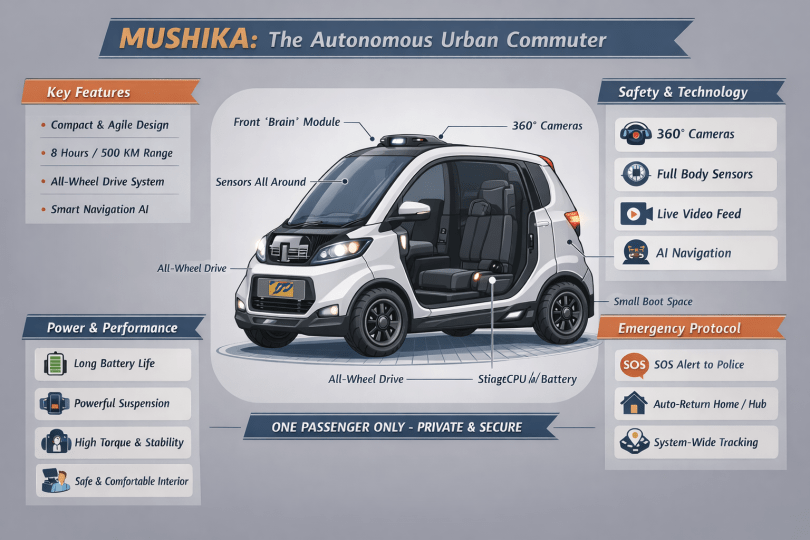
Mushika is an autonomous, battery-powered, all-wheel-drive compact vehicle, designed specifically for Indian cities.
Like a mouse, it can move through the tightest lanes. But beneath its small frame lies a powerful intelligence.
Unlike existing platforms such as Google Maps, Uber, Ola, or Rapido, Mushika uses:
Indigenously developed Indian road maps
Real-time video feeds monitored by human agents
AI that learns continuously from traffic, roads, and behaviour
Vehicle-to-vehicle communication to regulate traffic like a grid
Mushika doesn’t just move through traffic—it coordinates with it.
Privacy, Safety, and the Hive System
Mushika offers something most urban transport does not—privacy.
Only one passenger travels at a time.
This makes Mushika especially safe and comfortable for working professionals and women, particularly during late hours. There is no need to share space with unknown passengers.
Safety is built into the system at multiple levels.
If Mushika loses internet or server connectivity for more than 60 seconds, it automatically sends an SOS alert to the nearest police station.
Simultaneously, the central server issues an alert across all systems.
Every Mushika unit begins tracking the disconnected vehicle.
Mushika operates like a hive.
If one unit is lost, the entire system reacts.
No vehicle is ever truly alone.
How Mushika Is Built
Mushika is a two-part system.
The Brain (CPU)
Installed at home or in a secure server hub. This handles complex processing, learning, and coordination.
The Body (Vehicle)
A compact, Activa-sized vehicle with two partitions:
Front: onboard brain module handling real-time commands
Back: comfortable single-passenger seating
If Mushika temporarily loses server access, it switches to basic autonomous protocols:
Continue towards destination safely
Avoid all obstacles
Attempt reconnection continuously
If reconnection fails, return to its designated hub or home location
Mushika always knows where it belongs.
Corporate & City-Level Impact
For corporate employees, Mushika becomes a moving workspace.
Employees can work, read, or rest without worrying about traffic, accidents, or fatigue. Companies partner with Mushika to manage employee transport efficiently and safely.
Inspired by Wall-E and even my robotic vacuum cleaner, Mushika calculates optimal routes, predicts congestion, and returns to its charging hub automatically after dropping the passenger.
Today, Mushika operates in five major Indian cities, including Hyderabad, Telangana.
Tomorrow, the vision is to spread nationwide.
I may not have started with the right degree.
But I started with the right belief.
And sometimes, that is enough to move an entire country forward.
Thank you.
 My Journey
[…] Mushika Chapter 2: How It Works, Why It Matters, and What It Protects […]